
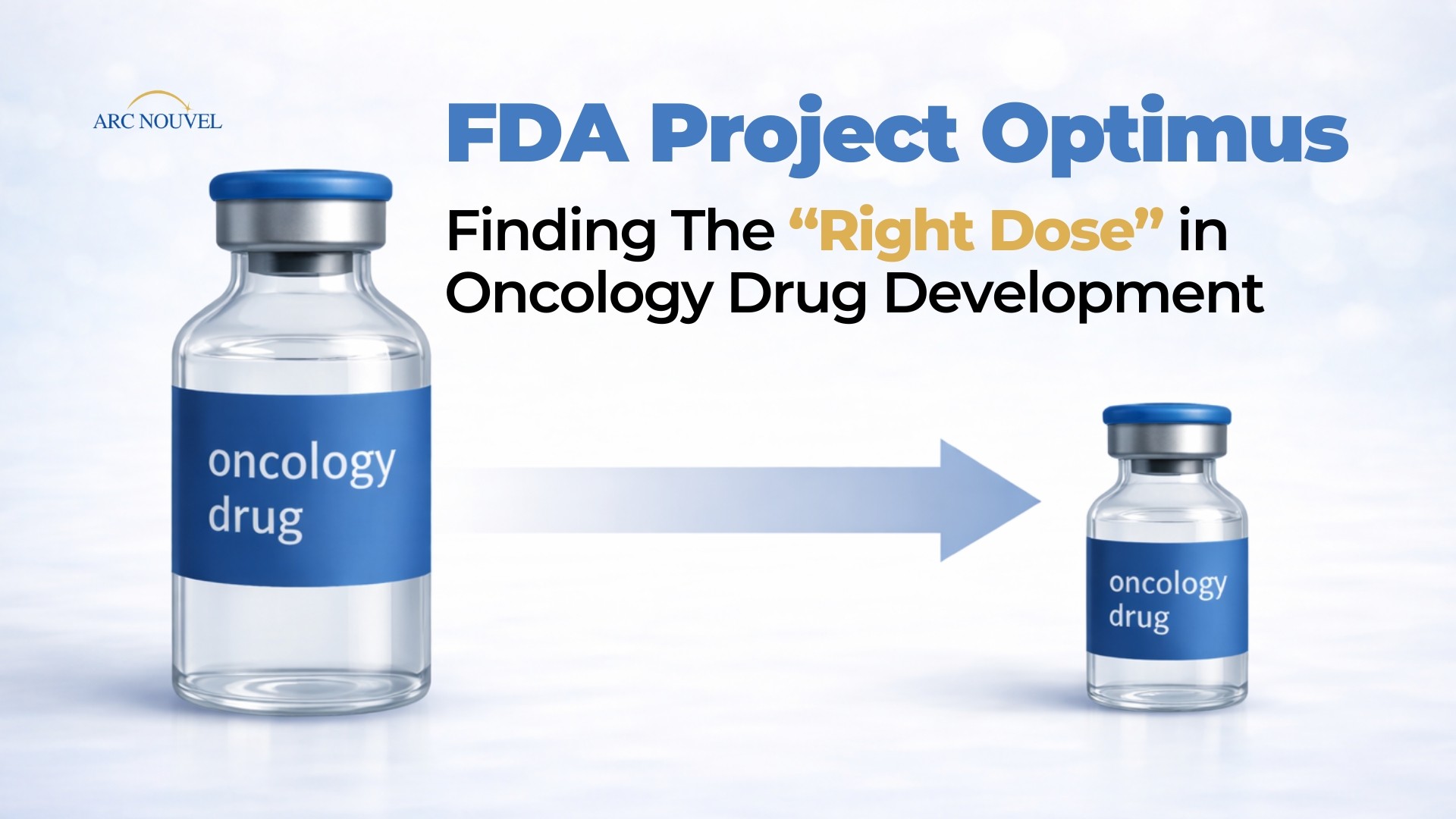

Oncology drug development is undergoing a fundamental methodological transformation. With the launch of Project Optimus in 2021, the U.S. Food and Drug Administration (FDA) formally signaled that the historical paradigm centered on identifying the maximum tolerated dose (MTD) is no longer sufficient for many modern cancer therapies. Instead, regulators are calling for a more comprehensive, patient-focused approach that balances efficacy, safety, and long-term tolerability.1
For sponsors and clinical development leaders, this shift represents a structural change in evidentiary expectations rather than a routine regulatory update. Programs that fail to adapt risk increased regulatory scrutiny and potential delays. Project Optimus reflects a broader movement toward integrating exposure–response science into oncology development decisions. 2
Historical Context: The MTD Paradigm
The maximum tolerated dose paradigm emerged during the era of cytotoxic chemotherapy, when antitumor activity often increased with dose intensity and toxicities were typically acute and rapidly observable. Under those conditions, identifying the highest tolerable dose was a scientifically reasonable strategy and became deeply embedded in oncology drug development practice. 2
However, the therapeutic landscape has changed profoundly. Modern oncology agents, including targeted therapies, monoclonal antibodies, and immunotherapies, often demonstrate exposure–response plateaus and are administered continuously rather than in short cycles. These characteristics weaken the historical assumption that higher dose necessarily yields greater clinical benefit. 3
Post-marketing data have shown frequent dose reductions for many oncology drugs, suggesting that labeled doses were not always optimized for long-term use. In certain cases, the FDA has required sponsors to formally evaluate lower doses. For example, with sotorasib, the FDA determined that the approved 960-mg once-daily dose had not been fully optimized and required a postmarketing randomized study comparing 240 mg with 960 mg daily.4, 5 In that trial, objective response rates were 32.7% with 960 mg versus 24.8% with 240 mg, with similar median progression-free survival (5.4 vs 5.6 months) and overall survival (13.0 vs 11.7 months).6 Earlier experience with agents such as sunitinib also demonstrated that alternative dosing schedules (e.g., a 2-weeks-on/1-week-off schedule) could improve tolerability with broadly comparable antitumor activity relative to the original 4-weeks-on/2-weeks-off regimen. 7 The FDA has explicitly cited such experiences as part of the rationale for Project Optimus.1
What Project Optimus Is Designed to Achieve
Project Optimus represents a deliberate regulatory effort by the U.S. Food and Drug Administration to recalibrate how oncology dosing decisions are generated and justified. Rather than focusing narrowly on identifying the maximum tolerated dose, the initiative promotes a more integrated scientific framework that characterizes the full relationship among dose, systemic exposure, pharmacodynamic activity, clinical efficacy, and toxicity. The FDA Oncology Center of Excellence describes Project Optimus as an effort to reform dose optimization in oncology drug development and to encourage selection of doses that maximize overall clinical benefit for patients. 1
At its core, the initiative reflects the agency’s view that dose selection is not a single-point decision but an evidence-generation process that should evolve iteratively throughout development. Project Optimus seeks to ensure that dose justification is grounded in a robust understanding of exposure–response relationships rather than relying primarily on toxicity thresholds. This shift is particularly relevant for targeted therapies and biologics, where pharmacologic activity often saturates before dose-limiting toxicity is reached. 2
The FDA’s August 2024 final guidance provides the most explicit regulatory articulation of these expectations. The agency states that the guidance is intended to assist sponsors in identifying an optimized dosage during clinical development, ideally prior to initiation of Phase 3 studies and submission of a marketing application. Importantly, the document emphasizes that dosage optimization should be supported by the totality of evidence, including safety data, pharmacokinetics, pharmacodynamics, exposure–response analyses, and clinical activity. This language signals that dose justification has become a central component of regulatory decision-making rather than a secondary consideration.8 Accordingly, the FDA increasingly expects randomized dose evaluations to reduce the risk of bias associated with sequential, non-randomized dose-escalation approaches.
A critical, and sometimes underappreciated, dimension of Project Optimus is the FDA’s explicit focus on long-term tolerability. Many modern oncology therapies are administered continuously until disease progression, making cumulative low-grade toxicities and treatment adherence clinically meaningful determinants of benefit. High-impact literature notes that the initiative is intended to move the field toward doses that patients can realistically maintain over extended treatment durations, thereby improving the real-world effectiveness of approved therapies. 3
The FDA has also been clear that accelerated or expedited development pathways do not justify bypassing dose optimization. In the final guidance, the agency explicitly cautions that participation in programs such as Breakthrough Therapy designation or Accelerated Approval does not eliminate the need to adequately characterize dose–exposure–response relationships. This position reflects the agency’s broader concern that insufficient early dose work can lead to post-approval uncertainty, including the need for label modifications or additional studies. 8
From a regulatory science perspective, Project Optimus therefore aims to achieve several interconnected objectives:
- It seeks to reduce reliance on empiricism in oncology dose finding
- Increase the quantitative rigor of clinical pharmacology packages
- Encourage earlier integration of model-informed drug development
The initiative is characterized as part of a broader evolution toward more data-rich, patient-centered oncology development paradigms. 9
Ultimately, the initiative signals a clear FDA expectation: sponsors should be able to explain, not merely observe, why the proposed dose provides the optimal balance of efficacy, safety, and tolerability. Programs that generate this level of evidence early are likely to face fewer regulatory uncertainties, while those that rely primarily on traditional MTD logic may encounter increasing scrutiny as Project Optimus continues to mature.
Why “More” Is Not Always Better
The scientific foundation of Project Optimus is supported by a growing body of high-impact research demonstrating that many modern oncology drugs achieve maximal or near-maximal biological activity at exposures below the MTD. Beyond this point, further dose escalation primarily increases toxicity burden without improving clinical outcomes. 3
This issue is particularly relevant for therapies intended for chronic administration. Continuous dosing magnifies the clinical importance of cumulative tolerability, low-grade symptomatic adverse events, and treatment adherence. High-impact reviews note that optimizing long-term tolerability is increasingly central to maximizing overall therapeutic benefit in oncology. 2
Stakeholder perspectives reinforce this shift. A survey analysis published in Clinical Pharmacology & Therapeutics reported that 53% of patients and 85% of oncologists believe higher doses are not necessarily more effective, and more than 90% expressed openness to dose optimization strategies. 9
As authors mention, “Higher doses are not necessarily more effective.”
The 2024 FDA Final Guidance: Raising the Evidentiary Bar
The August 2024 final guidance formalizes FDA expectations and represents the clearest regulatory articulation of Project Optimus principles to date. The document emphasizes that dosage selection should be based on the totality of evidence, including safety, pharmacokinetics, pharmacodynamics, exposure–response analyses, and clinical activity.8
The agency explicitly cautions against relying solely on toxicity alone as the primary determinant of dose. Instead, sponsors are encouraged to characterize dose–exposure–response relationships early and thoroughly. This expectation represents a meaningful departure from historical oncology development practices.8
The guidance also notes that evaluating multiple dose levels can reduce uncertainty in dose selection and improve confidence in the chosen regimen. While not universally mandated, randomized dose comparisons are increasingly viewed as best practice when feasible.5
Implications for Early-Phase Trial Design
Project Optimus is already reshaping the scientific and operational architecture of early oncology development. Historically, first-in-human oncology trials relied heavily on small-cohort, toxicity-driven escalation designs, most notably the rule-based 3+3 design, to identify the maximum tolerated dose. While operationally simple, these designs were not constructed to characterize exposure–response relationships or to support selection of an optimal biological dose. The FDA has increasingly signaled that such approaches, when used in isolation, may be insufficient for modern oncology programs.1
In response, contemporary Phase I studies are increasingly transitioning from empirical 3+3 designs to model-assisted or model-based approaches (e.g., BOIN), which enable more efficient and data-rich dose finding. 10 The FDA now increasingly expects early-phase programs to generate richer clinical pharmacology datasets capable of supporting dose justification. The agency’s 2024 final guidance emphasizes that dosage optimization should be informed by the totality of evidence, including pharmacokinetics, pharmacodynamics, safety, and exposure–response analyses. As a result, Phase I protocols are evolving to incorporate more intensive PK sampling, biomarker integration, and model-informed dose escalation approaches. 8
Expansion cohort strategy is also undergoing meaningful redesign. Rather than expanding a single dose level presumed to be the MTD, regulators increasingly encourage evaluation of multiple dose levels within early development to reduce uncertainty around the benefit–risk profile. High-impact literature notes that such designs enable earlier identification of exposure–response plateaus and may prevent late-stage surprises regarding tolerability. 3
Another important implication is the growing role of quantitative methods. Model-informed drug development (MIDD), Bayesian adaptive designs, and exposure–response modeling are becoming central tools for sponsors seeking to align with Project Optimus expectations. The FDA has repeatedly emphasized that early integration of these approaches can improve confidence in dose selection and support more efficient development pathways. 8
Collectively, these changes indicate that early oncology development is moving from a primarily empirical paradigm toward a quantitatively driven, hypothesis-testing framework in which dose optimization is a continuous process rather than a single escalation endpoint.
Strategic Consequences for Sponsors
For sponsors, Project Optimus introduces both near-term operational demands and longer-term strategic advantages. Early development programs may require larger expansion cohorts, more intensive clinical pharmacology, and earlier use of quantitative modeling. High-impact analyses acknowledge that these requirements can increase upfront complexity and cost. 3
However, the FDA’s position reflects a lifecycle risk-management perspective. The agency has emphasized that optimized dosage should be identified during development rather than deferred to the post-marketing setting. 8 So, when approved doses align closely with the MTD, adverse-event-driven discontinuation rates tend to be higher, potentially undermining real-world effectiveness. 3
Sponsors that invest early in rigorous dose optimization may therefore achieve more durable labeling, improved treatment adherence, and reduced post-approval uncertainty. Conversely, programs that rely primarily on traditional MTD logic without robust exposure–response evidence may face increasing regulatory scrutiny as Project Optimus expectations continue to mature. 2
Project Optimus should be viewed within the wider transformation toward precision, patient-centered oncology drug development. High-impact commentary characterizes the initiative as part of a broader effort to align drug development with the realities of modern cancer care, particularly the importance of long-term tolerability and quality of life. 9
This evolution parallels advances in model-informed drug development, adaptive trial methodology, and biomarker-driven strategies. Collectively, these trends are moving oncology toward a more individualized and data-rich dosing paradigm, with Project Optimus serving as a key regulatory catalyst. 2
Key Takeaways
- Project Optimus marks a major FDA initiative to modernize oncology dose selection and move beyond the historical MTD paradigm.
- The 2024 FDA final guidance formally expects sponsors to identify optimized dosage regimens during clinical development using the totality of evidence.
- Modern oncology therapies often show efficacy plateaus below the MTD, making toxicity-driven dose selection potentially suboptimal.
- Both patients and oncologists increasingly recognize that higher doses are not necessarily more effective, supporting the shift toward optimized dosing.
- The FDA now emphasizes early, rigorous characterization of dose–exposure–response relationships and encourages evaluation of multiple dose levels.
- Project Optimus is already driving a paradigm shift in early-phase oncology trial design and increasing expectations for clinical pharmacology integration.
- Although early development complexity may increase, optimized dosing is expected to improve tolerability, adherence, and long-term clinical benefit.
About Arc Nouvel Clinical Development Consulting
Arc Nouvel Clinical Development Consulting LLC is a boutique consulting firm dedicated to delivering comprehensive clinical development solutions for pharmaceutical, biotechnology, and investment clients. We specialize in strategic consulting, operational support, and executive coaching tailored to clinical trial programs from early to late phases. With deep expertise in oncology, including early-phase studies and dose-finding approaches, and a commitment to innovation, quality, and client success, we partner closely with sponsors from concept through completion, bridging scientific rigor with operational excellence.