

The FDA Accelerated Approval (AA) pathway remains one of the most powerful regulatory mechanisms in oncology, enabling earlier patient access to promising therapies. However, accelerated approval is inherently conditional. When confirmatory trials fail to verify clinical benefit, or are not completed in a timely manner, the FDA has demonstrated increasing willingness to withdraw indications.
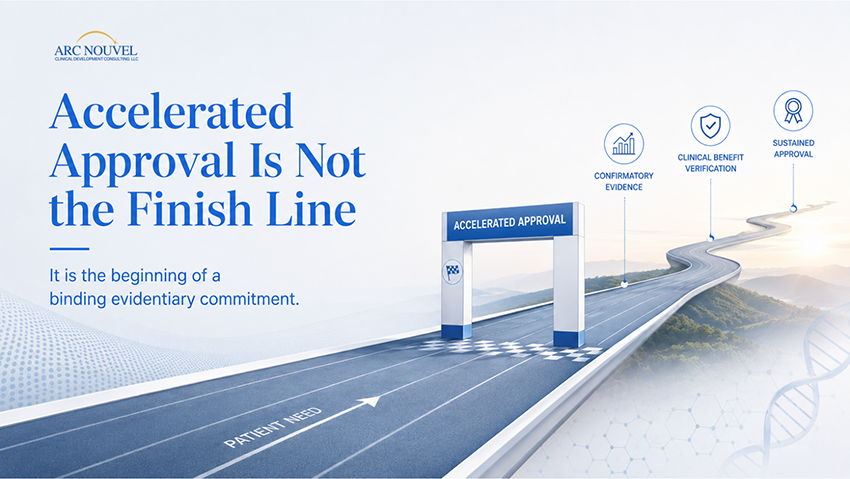
Over the past decade, regulatory scrutiny has intensified. Several high-profile oncology indications have been voluntarily withdrawn or formally revoked, underscoring a critical reality for sponsors: accelerated approval is not the finish line but the beginning of a binding evidentiary commitment.
This article examines:
- The legal and regulatory framework for withdrawal
- Patterns in recent FDA enforcement
- Case studies of withdrawn oncology indications
- Strategic inflection points for sponsors
- Implications for future development programs
The Conditional Nature of Accelerated Approval
Under Subpart H (21 CFR § 314.510), FDA may grant accelerated approval based on a surrogate endpoint or an intermediate clinical endpoint reasonably likely to predict clinical benefit, subject to required post-marketing confirmatory studies. 1
FDA has repeatedly emphasized that failure to confirm benefit may result in withdrawal. A large analysis in JAMA Internal Medicine found that delays in confirmatory studies can leave patients exposed to drugs with unverified benefit. 2
After accelerated approval, oncology indications typically follow one of three trajectories:
- Conversion to regular approval
- Continued accelerated approval (“dangling”)
- Withdrawal (voluntary or FDA-initiated)
A comprehensive review in The BMJ estimated that roughly 10–15% of oncology accelerated approval indications have ultimately been withdrawn, highlighting the material regulatory risk inherent in the pathway. 3
FDA Authority and Withdrawal Pathways
FDA’s authority to withdraw accelerated approvals is explicitly codified for drugs under 21 CFR 314.530 and for biologics under 21 CFR 601.43. 4, 5 These provisions allow the Agency to remove an indication when confirmatory trials fail to verify benefit, are not conducted with due diligence, or when emerging evidence alters the benefit–risk assessment.
FDA oversight has become more systematic and active in recent years. Through initiatives such as Project Confirm, the Oncology Center of Excellence systematically tracks post-approval obligations and promotes timely verification of clinical benefit. 6
Voluntary Sponsor Withdrawal
In contemporary oncology practice, most accelerated approval withdrawals are sponsor-initiated. A major BMJ analysis found that the majority of oncology AA removals were voluntary and typically followed confirmatory trials that failed to meet primary endpoints. 3
Common drivers include:
- Negative confirmatory results
- Inability to complete required studies with due diligence
- Rapid evolution of the treatment landscape
From a strategic perspective, voluntary withdrawal often represents disciplined lifecycle management. Early action allows sponsors to maintain regulatory credibility and control stakeholder communications while aligning with FDA expectations.
FDA-Initiated Withdrawal: Bevacizumab (Avastin) Case
Although less common today, FDA-mandated withdrawal remains the Agency’s most consequential enforcement tool. The defining precedent is bevacizumab (Avastin) in metastatic breast cancer.
FDA revoked this indication after confirmatory trials failed to demonstrate overall survival benefit and raised safety concerns. The Agency concluded the drug had not been shown to be safe and effective for this use. 7 A detailed analysisconfirms that modest PFS gains without survival improvement were insufficient to sustain approval. 8
Strategic signal: accelerated approval requires not only early activity but durable clinical meaningfulness.
Checkpoint Inhibitor Withdrawals (2020–2021)
Beginning in 2020, FDA, through Project Confirm, intensified review of oncology accelerated approvals with unresolved or negative confirmatory evidence. 6 This period marked a visible enforcement inflection point.
Key withdrawals
FDA’s withdrawn accelerated approvals database documents several high-profile immune checkpoint inhibitor removals:
- Pembrolizumab, metastatic small cell lung cancer (withdrawn March 30, 2021)
- Nivolumab, metastatic small cell lung cancer (withdrawn December 29, 2020)
- Durvalumab, platinum-treated urothelial carcinoma (withdrawn February 19, 2021)
- Atezolizumab, platinum-treated urothelial carcinoma (withdrawn April 13, 2021)
These withdrawals largely followed confirmatory trials that failed to demonstrate improvement in primary endpoints. 3
Evidence Linkage
High-impact trial data help explain these outcomes:
- Nivolumab in relapsed SCLC: Phase 3 evidence showed no overall survival advantage versus chemotherapy. 9
- Durvalumab (DANUBE): Failed to meet overall survival endpoints. 10
- Atezolizumab (IMvigor211): Did not significantly improve OS in PD-L1–high population. 11
- Pembrolizumab in SCLC: The indication was voluntarily withdrawn following consultation with FDA after confirmatory data did not support conversion to regular approval. 12
Strategic lesson
Class success does not ensure indication success. Each accelerated approval must independently verify clinical benefit on endpoints acceptable to regulators.
The Problem of “Dangling” Accelerated Approvals
“Dangling” accelerated approvals are indications that remain marketed despite negative, inconclusive, or substantially delayed confirmatory evidence. A cross-sectional study in JAMA Internal Medicine documented multiple oncology cases with prolonged unresolved status. 2
These situations typically arise from structural challenges, including difficult trial feasibility, rapidly evolving standards of care, and small biomarker-defined populations. Historically, variability in enforcement timelines also contributed.
Today, regulatory tolerance for prolonged evidentiary uncertainty appears to be narrowing. Through Project Confirm, FDA has moved toward more active lifecycle oversight and timelier resolution of accelerated approvals. 6
Strategic implication: Sponsors should assume the window for unresolved accelerated approvals is steadily shrinking.
When Is Withdrawal the “Right Moment”?
Determining optimal withdrawal timing remains complex, but several evidence-based inflection points consistently emerge.
Definitive Negative Confirmatory Trial
Failed confirmatory trials remain the dominant driver of withdrawal. Many withdrawn indications were initially supported by response-rate surrogates that did not translate into survival benefit. 3
Best practice: reassess promptly following clearly negative data.
Prolonged Confirmatory Delays
Evidence indicates that completion of confirmatory trials following accelerated approval can be substantially delayed, with multiple studies reported as delayed, pending, or ongoing, demonstrating that considerable time may elapse before clinical benefit is verified. 2 Recent FDA communications increasingly emphasize early initiation, feasible enrollment, and continuous progress monitoring.
Changing Standard Of Care
Rapid evolution, particularly in immuno-oncology, can erode the relevance of earlier evidence packages. Confirmatory trials must remain interpretable within the contemporary treatment paradigm. 3
Benefit–risk reassessment
Even without a failed trial, the totality of evidence may shift unfavorably, as illustrated by the bevacizumab decision. 8
Strategic Implications for Sponsors
Accelerated approval now demands front-loaded lifecycle planning. Sponsors should anticipate confirmatory feasibility, ensure surrogate robustness, and continuously reassess competitive and regulatory durability.
Regulatory experience shows that indications supported primarily by single-arm response data carry increasing risk of non-confirmation. 3 Accordingly, confirmatory trials are increasingly expected to be underway at the time of accelerated approval. 6
What It Means for a Confirmatory Trial to Be “Underway”
Where FDA requires a confirmatory trial to be underway before accelerated approval, an agreed protocol alone may no longer be sufficient. In its January 2025 draft guidance, FDA states that a confirmatory trial will generally be considered underway before accelerated approval when the trial has a target completion date consistent with diligent and timely conduct, the sponsor’s progress and postapproval plans provide sufficient assurance of timely completion, and enrollment in the confirmatory phase has begun.
FDA’s assessment is operational rather than merely documentary. The Agency may consider accrual achieved and the projected accrual rate, the number of active sites and pace of additional site activation, and measurable benchmarks—such as recruitment goals, site activation, or primary-endpoint events, that can demonstrate feasibility at the anticipated approval date. When accelerated approval could make recruitment more difficult, particularly when the confirmatory trial enrolls the same population as the proposed indication, FDA may expect all or a significant portion of enrollment, and in some cases complete enrollment, before approval.
In practical terms, a trial that is “well underway” should not be defined by a single universal enrollment percentage. It means that the confirmatory program has visible executional momentum: a regulator-aligned and feasible design, activated sites, actual enrollment in the confirmatory phase, progress against agreed milestones, adequate resources, and a credible path to timely completion. Sponsors that wait until after accelerated approval to solve site, recruitment, or retention problems may find that approval itself makes the trial harder to finish.
Strategic implication: confirmatory execution should be treated as a pre-approval workstream, with enrollment and site-activation milestones stress-tested early enough to identify and correct feasibility gaps before the FDA action date.
Because most modern withdrawals are sponsor-initiated, proactive action can preserve credibility and reduce the likelihood of formal FDA revocation. At the same time, global regulatory divergence is growing; some indications withdrawn in the United States have remained approved elsewhere, requiring coordinated international strategy. 3
FDA’s Direction of Travel
Regulatory signals point toward continued maturation, and tightening, of the accelerated approval framework. FDA is applying more rigorous scrutiny to surrogate endpoints, particularly where correlation with survival is inconsistent, while increasingly expecting confirmatory trials to be operational early in the approval lifecycle. 6
The Oncologic Drugs Advisory Committee is also playing a more visible role in reassessing both new and legacy indications, reflecting a more transparent and multidisciplinary review environment.
Importantly, FDA continues to affirm that accelerated approval remains essential for therapies addressing serious and life-threatening diseases. Current enforcement trends should therefore be viewed not as retrenchment, but as an effort to preserve the pathway’s credibility by ensuring that early access is paired with timely, scientifically robust confirmation of benefit.
How Arc Nouvel Supports Sponsors
The evolving accelerated approval environment demands sophisticated lifecycle strategy. Arc Nouvel Clinical Development Consulting partners with sponsors to navigate accelerated approval from feasibility through confirmatory execution and lifecycle risk management.
We help sponsors:
- Assess accelerated approval suitability
- Stress-test surrogate endpoint strategy
- Design regulator-ready confirmatory programs
- Develop measurable trial-progress benchmarks and align them with FDA expectations
- Build site-activation and enrollment plans capable of meeting pre-approval milestones
- Identify accrual and retention risks early and remediate delays before the approval action date
- Anticipate withdrawal risk
- Manage complex post-approval interactions
In today’s regulatory environment, success in accelerated approval is defined not only by achieving early approval, but by sustaining it through rigorous, timely evidence generation.