
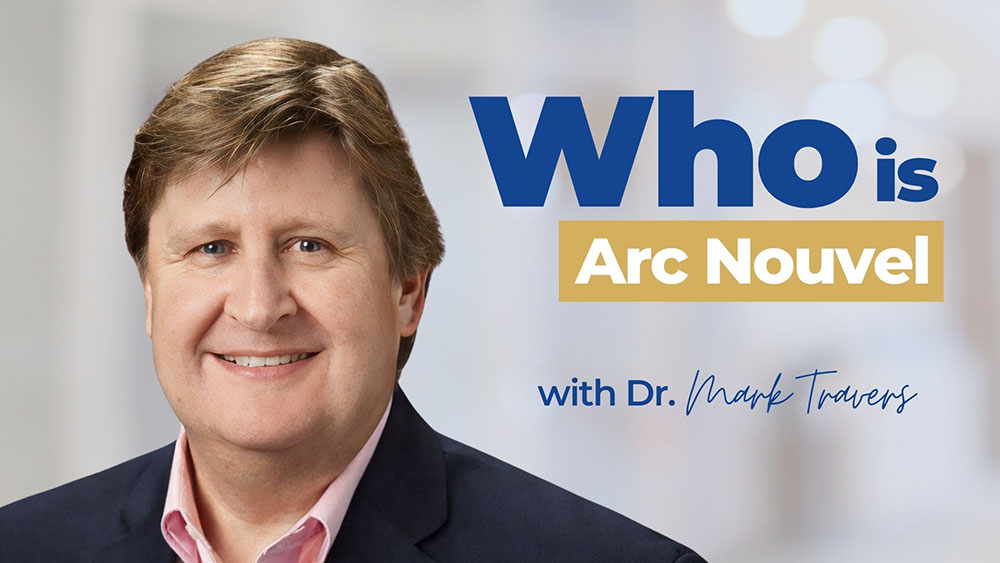

The “Who Is Arc Nouvel” series highlights the people who give our company its edge. This time, the spotlight is on Dr. Mark Travers, one of the next gems of Arc Nouvel and a leader whose career has been shaped at the highest levels of clinical development.
Every promising program eventually faces the same hard question: can it be executed in the real world, across countries, across sites, across regulatory expectations, and under the pressure of time? Dr. Travers has spent nearly four decades answering that question.
From his beginnings as a CRA with Yamanouchi in the UK to senior leadership roles across Johnson & Johnson, Sanofiand Merck, Travers built the kind of career that serious drug development organizations recognize immediately: technically grounded, globally tested, and operationally decisive. He understands not only how clinical trials are designed, but how they are truly delivered.
Built from the Ground Up
The authority Dr. Mark Travers brings to clinical development does not come from having observed the industry from above. It comes from having learned it at the level where trials either hold together or begin to unravel. His route through the field started in scientific training, moved through devices, and then into pharmaceuticals, but the defining foundation was built in site-facing clinical research.
That early chapter still shapes the way he thinks. “You learn so much when you’re a CRA,” he says. “It is, for me, the basis, the platform from which you build to become successful in all aspects of global clinical trial operations.”
What he learned there was not just process. It was proportion: how much depends on timing, trust, site readiness, and whether the people closest to the protocol have what they need to make it work. It is also why he has remained unusually loyal to the importance of frontline clinical roles.
“They are our eyes and ears on the ground,” he says of CRAs. “They’re the ones that are interacting with the sites on a regular basis, responsible for making sure that the patients are safe, protocol is followed according to the instructions within the protocol and according to GCP, and the data is of good quality.” The feeling behind that view has not faded with time. “I’ve never forgotten my time as a CRA,” he says. “I thoroughly enjoyed it.”
That is an important starting point, because it explains why Travers’s judgment feels operational rather than merely strategic. He did not begin with abstract frameworks and later move toward reality. He began with reality, and everything else was built on top of it.
Trials Must Be Fit for Purpose
From that foundation comes one of the clearest ideas in his worldview: complexity is not the same as quality. Clinical development often rewards intellectual ambition, but Travers is most interested in whether that ambition produces a study that can actually be carried by patients and sites without losing coherence.
He is especially alert to the point at which scientific sophistication begins to drift away from real-world feasibility.
“Sometimes the scientists and physicians are a little bit too far away from the patients,” he says.
That distance matters, because patients do not experience a protocol as a conceptual achievement. They experience it as burden, disruption, and risk. As Travers puts it, “It’s a patient that is going to look at this study and they’re going to consider, ‘Is this study the right study for them? What are the risks? And how much is that going to impact their day-to-day life?’” Sites make a similar calculation, even if it is less visible. “There’s the burden on the patient. There’s also the burden on the site staff, the study nurse and the physicians that are running the clinical trial.”
That is why he returns so often to a deceptively simple standard.
“Sometimes the studies are very complex, scientifically and medically of a high standard, but they’re not fit for purpose for registration.” Then he states the corrective principle with characteristic clarity: “The aim is the protocol should have the minimal burden on the patient, minimal burden on the investigational site staff. It should be fit for purpose to answer the questions within the protocol and also the requirements of the regulatory authorities.”
In other words, good development is not about stuffing a study with everything a team might want to know. It is about designing something disciplined enough to answer what matters.
What Strong Sponsors Get Right Early
Because Travers has seen programs at so many stages, he pays close attention to the mistakes that are made long before they are visible in timelines or topline results. In his view, many weaknesses appear early, especially when sponsors confuse confidence with readiness.
The companies that build stronger programs are usually the ones that are willing to test their assumptions early and rigorously. That means engaging regulators with clarity, not defensiveness. It means being precise about the population, the study design, the endpoints, the evidence package, and the practical demands of the program that follows.
“I think they have to get a clear understanding from the good discussions with the regulatory authorities on what studies that they’re going to run, what are the patient populations that they’re going to get to study the product in, the type of studies that they’re going to run, the measurements, the biomarkers, the assessments,” he says. Just as importantly, “They have to be very, very open in terms of their plans.” And the real operating discipline comes after that: “A lot of dialogue, a lot of consultation, a lot of discussion. And again, making sure that everybody’s comfortable with the path forward.”
What makes this useful is that it is not generic advice. Travers is pointing to a particular posture: seriousness, openness, and a willingness to shape development through evidence rather than optimism. He has seen what happens when feasibility is overstated, when timelines become fictional, or when a protocol is designed too far from the conditions of actual care. His perspective is a reminder that good programs are usually not the boldest-sounding ones. They are the ones built on the strongest early discipline.
Why Patients and Sites Belong in the Design, Not Just the Discussion
One of the strongest threads running through Travers’s thinking is that patient centricity only becomes meaningful when it changes the study itself. Otherwise, it remains a phrase.
He speaks about patient involvement in practical terms, not symbolic ones. If the voice of the patient is missing when a protocol is built, that absence tends to show up quickly: recruitment becomes harder, retention weakens, and burden increases in ways teams could have anticipated. Travers is supportive of bringing patient groups into the conversation earlier, especially around inclusion approaches, recruitment materials, and study assessments.
That instinct follows directly from his broader philosophy: a better trial is one shaped not only by science and regulation, but also by the realities of living with the disease being studied.
“The patients have a role to play,” he says. “Their voice is important and appreciated.” And when that perspective is balanced properly, “you get the balance right between the voice of the patient, the needs of the regulatory authorities and the expertise of the pharma company.” In his view, “all of them play an important role in designing a clinical trial.”
That same logic extends to sites. Travers has long argued that monitoring and site-facing operations are not administrative layers to be tolerated, but quality engines to be strengthened.
“Look after your CRA workforce, make them a core competency, give them the tools to do the job, to build the relationship, and give them the opportunity to effectively manage the site,” he says. The reason is not sentimental. “They are there on a regular basis. They are the eyes and ears of the pharma company.” And because they are the people who sustain real site relationships, “their professionalism, their drive, and their motivation gets it done.” The narrative is continuous here: if patients and sites bear the weight of study execution, then serious development has to treat their realities as central design inputs, not downstream inconveniences.
Speed is Not a Branding Word
Travers’s perspective on speed is one of the most compelling parts of his overall philosophy because he strips it of cliché. He is not interested in speed as posturing. He is interested in what unnecessary delay costs.
A defining moment came in meeting a patient whose life had been changed by Keytruda. The encounter clearly crystallized something that had been present in his thinking for years. “It was a very emotional moment,” he says, recalling how the patient and his wife thanked him and the wider teams behind the work. The patient’s message was simple and unforgettable: “Please thank all of the people who worked on these clinical trials. I may never meet them, but please thank them, because I am here today because of them.” What stayed with Travers was the human translation of operational performance. “This is the goal,” he says. “When people start to develop the drugs, this is the end goal.”
That experience sharpened the way he talked to colleagues about time.
“Think of all the other people we could save if we did it a little bit faster,” he says. “If we did it quicker, a week quicker, a month quicker, three months quicker, how many more would we have saved?”
This is not the language of acceleration for its own sake. It is the language of someone who understands that avoidable friction has moral weight. In Travers’s frame, speed matters because patients are waiting, not because companies like urgency narratives.
On AI: Interested, Hopeful, and Unsentimental
That same realism shapes his view of AI. Travers is not dismissive of new technologies; in fact, he is actively engaged with them. But he is careful about where promise ends and proven value begins.
He can see genuine potential in multiple parts of drug development.
“I’ve seen some areas where AI has potential benefit around maybe drafting the protocol, helping with the informed consent, maybe identifying some countries and physicians who may be able to do parts of the study, aspects of data management, aspects and helping with the final analysis and the production of the final clinical research report.”
Still, the most interesting question for him lies elsewhere.
“The area that I would like to probably go a little bit further is where can AI help with respect to identifying and recruiting patients?”
That focus is telling. Even in thinking about technology, he is drawn back to the bottlenecks that shape real trial delivery.
But he is equally clear about the boundary conditions.
“We have to find technology that works for pharma across all of the countries,” he says, “but we also still have to have that human element in there to make sure that what AI produces is accurate and correct and suitable.” He even frames his optimism cautiously: “So there’s great hope for AI, and I hope this is not a false dawn.”
The continuity with everything else he says is clear. Innovation is valuable to him only when it survives contact with the real world and improves execution without weakening trust, quality, or judgment.
Leadership as Development, Not Just Delivery
One of the quieter but more revealing parts of Travers’s perspective is the importance he places on people development. For someone with such a large operational career, he does not define achievement only in terms of products, approvals, or global reach.
He is proud of the programs he has helped deliver, but he is just as proud of the people he has helped grow.
“I’m really very, very proud of the number of colleagues I’ve helped grow as individuals, develop professionally and fulfill their ambition,” he says.
He speaks especially about colleagues who needed someone else to see their capacity before they could fully see it themselves. “I believed in them,” he says, and “I’ve been prepared to mentor and coach them.” That trust was not abstract encouragement; it was practical sponsorship. He gave people room to grow because he believed they could do more. “I trusted them and had faith in them that they could do a really good job.”
That is a fitting place to end, because it completes the picture. The same person who insists on realistic protocols, stronger site relationships, better regulatory alignment, and more useful innovation also sees that none of it is possible without strong people.
In his worldview, development is never only about molecules or milestones. It is about the quality of thinking, judgment, and human capability around them. And that is what makes his perspective so usable: it is rigorous, but never detached from the people who have to carry the work forward.