
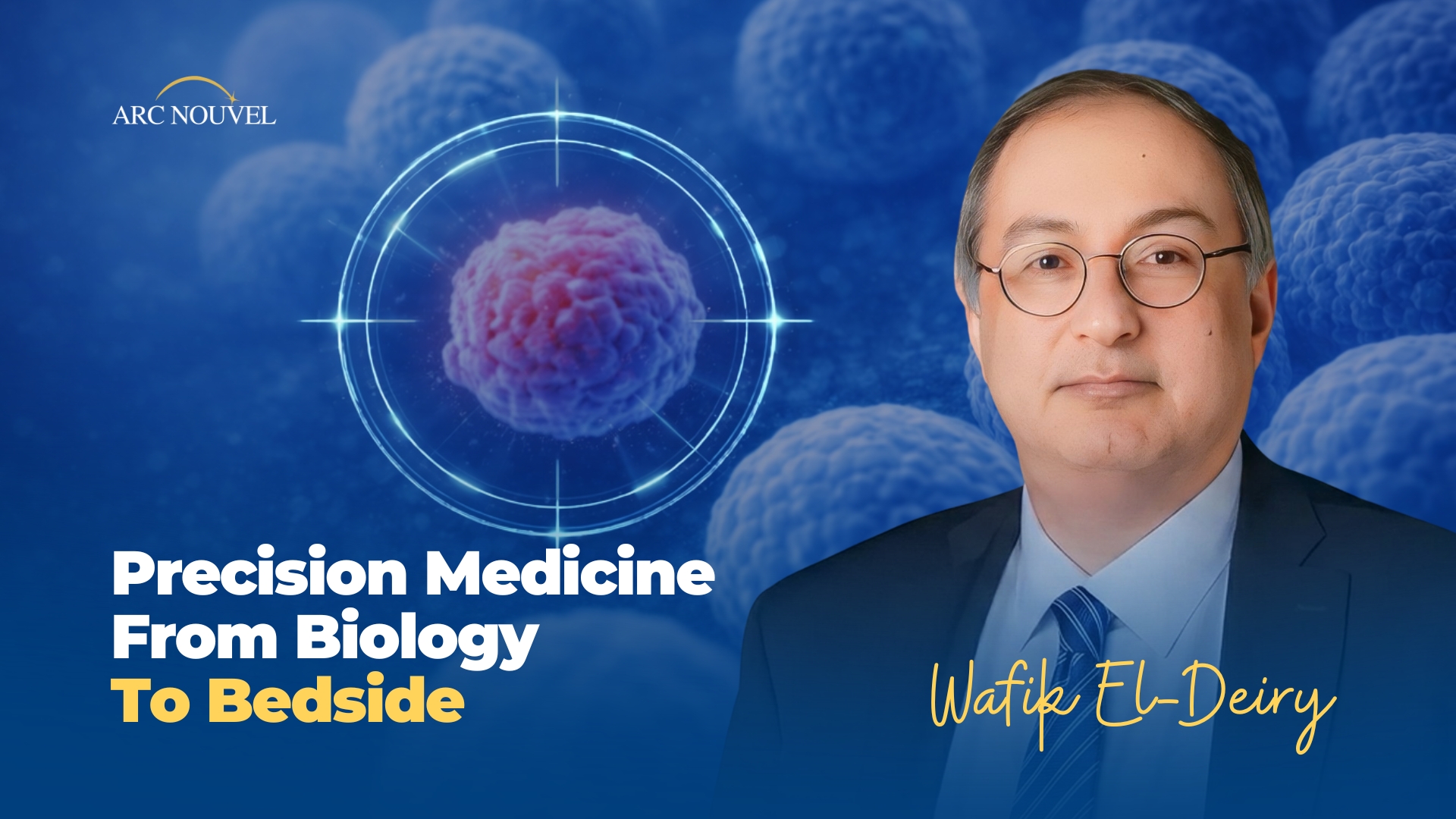

In the early 1990s, Wafik El-Deiry helped identify a gene that explained one of cancer biology’s most essential acts of restraint: how a damaged cell stops dividing.
The gene was p21, also known as WAF1. At the time, gene names were less ceremonious, and WAF1 carried a trace of his own name. The discovery helped clarify how the p53 tumor suppressor pathway responds to cellular stress, DNA damage, chemotherapy, and radiation, placing Dr. El-Deiry’s work within one of the central biological stories of modern oncology.
The discovery also helped give cancer biology a therapeutic vocabulary that remains active today. By showing that mammalian cell-cycle progression could be restrained through CDK inhibition, p21/WAF1 strengthened interest in pharmacologic CDK inhibitors, drugs that have since become important in breast cancer treatment and continue to be investigated across tumor types, including in El-Deiry Cancer Research Laboratory.
From that early work, Dr. El-Deiry’s career has stretched from basic cancer biology to translational therapeutics, clinical trials, and the global effort to make precision oncology more intelligent, collaborative, and accessible.
A Practicing Physician-Scientist
Dr. El-Deiry describes himself as a practicing physician-scientist, a role that carries two forms of responsibility. In the laboratory, he works with pathways, stress responses, immune signals, and therapeutic hypotheses. In the clinic, those ideas meet patients whose diseases rarely behave as cleanly as a diagram.
His early work on p21/WAF1 belongs to the era when cancer biology was still building the molecular grammar that later made precision oncology possible. Understanding how cells stop dividing under stress became part of a larger map of tumor suppression, DNA damage response, and treatment sensitivity. That map did not immediately produce a therapy, but it changed how the field understood cancer cells under pressure.
That kind of discovery can look inevitable only from a distance. Up close, Dr. El-Deiry describes it differently: as the product of people, timing, uncertainty, and sustained work. He does not frame major discoveries as acts of isolated brilliance, but as achievements made possible by teams, colleagues, and the unpredictable openings that science sometimes offers. Asked how it feels to be behind discoveries that have shaped the field, his answer is characteristically humble:
“It’s a privilege. I should say it’s a team effort. I am fortunate to have worked with very talented researchers in my group and colleagues. There is an element of serendipity and there is an element of hard work.”
The word “serendipity” matters. In precision oncology, rational design and unexpected biology often coexist. A pathway may suggest one direction, while patients reveal another. The scientist’s task is to be prepared enough to recognize significance when it appears.
That is how his later work on p53 and innate immune signaling became part of a therapeutic story. At the University of Pennsylvania, his group explored connections between the p53 tumor suppressor pathway and the innate immune system. That work contributed to the discovery of TRAIL-inducing compound number 10, later known as ONC201.
“I do believe that being grounded in science and rational drug design is very powerful eventually to make breakthroughs and have impact.”
Precision Oncology’s Long Memory
When Dr. El-Deiry speaks about precision oncology, he speaks as someone who watched the field grow from early molecular insight to treatment-defining practice. His examples move through some of the defining stories of modern oncology: the Philadelphia chromosome and imatinib in chronic myeloid leukemia, mismatch repair genes and checkpoint blockade in microsatellite instability, BRCA mutations and PARP inhibitors, EGFR mutations in lung cancer, and KRAS as both a resistance marker and a therapeutic challenge.
These examples are familiar, but in his telling they carry a larger message. Precision oncology advances when a molecular alteration is connected to a genuine dependency, a druggable vulnerability, or a clinically meaningful exclusion. It has helped identify who should receive a treatment, and just as importantly, who should not.
“Precision oncology has made a huge difference in the lives of patients whose tumors are driven by driver mutations and gene fusions.”
The word “driven” is essential. Many tumors carry alterations; fewer depend on them in a way that can be therapeutically exploited.
Dr. El-Deiry recalls the development of imatinib as one of the early proofs that a designer drug could change a disease. He also points to colorectal cancer, where precision medicine helped clarify that patients with KRAS mutations do not benefit from anti-EGFR therapy and may do worse. In lung cancer, drugs with initially low response rates became transformative once the responding subgroup was understood.
“Precision oncology has made a difference going back now a couple of decades in helping us understand who won’t respond to treatments.”
The field has also learned that the same mutation may not carry the same therapeutic meaning across cancers. BRAF inhibition in melanoma and colorectal cancer, for example, required different strategies. In colorectal cancer, the value of combining BRAF inhibition with anti-EGFR therapy took years to fully emerge. Precision medicine, in this sense, is a discipline of context.
“We have more targeted agents than ever in terms of how this field has evolved, but we still have many targets for which we don’t have treatments.”
That unresolved space keeps the field intellectually alive. KRAS, mutated p53, aggressive resistance biology, and complex tumor circuits remain difficult. Progress is real, but cancer still teaches by refusing simple conclusions.
ONC201
The ONC201 story carries particular weight because it links Dr. El-Deiry’s scientific past to a recent clinical milestone. The compound emerged from work aimed at boosting innate immune mechanisms and activating cancer cell stress pathways. Its later activity in H3 K27M-mutant diffuse midline gliomas was unexpected and deeply consequential.
These tumors are among the most difficult in neuro-oncology. They are often deep in the brain, difficult to operate on, and historically treated largely with radiation, with limited benefit from standard chemotherapy. On August 6, 2025, the FDA granted accelerated approval to dordaviprone, also known as ONC201, for adult and pediatric patients aged one year and older with H3 K27M-mutant diffuse midline glioma with progressive disease following prior therapy. The FDA described it as the first FDA approval of a systemic therapy for this disease setting.
For Dr. El-Deiry, the approval is exciting, but he does not flatten it into a triumphal story. He is precise about the remaining problem.
“It’s a very exciting breakthrough, and it’s clear that not all patients benefit from this therapy, and the benefit is not necessarily long-term. So those are obvious challenges and areas where we could do more.”
That statement reflects the discipline of translational oncology. Approval can validate a path, but it also sharpens the need to understand mechanism, resistance, combinations, and patient selection. ONC201’s journey highlights epigenetic biology, the integrated stress response, and the underused therapeutic potential of innate immunity.
“I think we need to keep an open mind about discovery and what could happen. This is an example where we had no idea this would happen.”
His laboratory is now interested in the tumor microenvironment, including macrophages in brain tumors. That interest reflects a broader shift in precision oncology. The malignant cell remains central, but its environment increasingly appears as a therapeutic landscape in its own right. Immune cells, stromal context, epigenetic state, stress responses, and therapy-induced changes can all influence whether a drug works.
“I didn’t know a few years ago that there’s such a high content of macrophages in brain tumors. Macrophages come in different varieties, and there is a complexity to all of this in terms of therapeutics and therapeutic targeting.”
The future of ONC201, for him, will likely depend on this deeper biology. The question becomes how to build next-generation trials from everything now known: how to target, how to combine, how to extend benefit, and how to help the patients who still do not respond.
AI is a Tool
Dr. El-Deiry approaches artificial intelligence with interest and caution. He sees its promise in digital pathology, image analysis, hypothesis generation, treatment prioritization, and functional precision medicine. He also sees its limits clearly.
In oncology, a persuasive computational output cannot substitute for evidence. AI may help clinicians and scientists work faster or see relationships they might otherwise miss. It may support the analysis of tumor circuitry rather than isolated mutations. But in a field where decisions affect survival, accuracy and accountability are not technical details.
“AI is a tool to help us do better.”
His use of the word “tool” keeps the discussion grounded. AI may assist, suggest, organize, enrich, or accelerate. It does not remove the need to test whether a therapy is safe and effective. This is especially relevant in functional precision medicine, where patient samples may be tested against selected drugs or combinations. Tissue is limited. Time is limited. AI may help decide what to test first.
“In functional precision medicine, you have to decide how many drugs you are going to test on those patient samples because you don’t have an infinite supply. AI is certainly an area that is useful there, and so it’s exciting, but it has limitations.”
His caution is sharpest when the conversation turns to therapeutic claims. A model may identify a possible drug. It may suggest a relationship. It may even predict benefit. But would a physician give an untested drug to a patient based only on that output? Dr. El-Deiry’s answer is careful, and it carries the weight of clinical responsibility.
“Do you really want AI to tell you that a certain drug that has never been tested in humans is going to be safe and effective, and would you take that drug and treat patients? I don’t know.”
He is more enthusiastic about AI as a companion to scientific thinking. In publishing and research, he sees potential for AI to help identify relationships, synthesize information, and generate hypotheses. But even there, the final standard remains truth, not fluency.
“Science and scientists pursue truth. I would use AI to help in the search for truth, but ultimately, you can’t make these things up. They either work or they don’t work.”
The Barriers Precision Medicine Still Has to Face
Precision oncology has changed care for many patients, but Dr. El-Deiry is direct about the barriers that continue to define the field. The first is access to molecular testing. The second is access to drugs. Without both, the logic of precision medicine breaks down.
“The very significant challenges include access to molecular testing to help us figure out how best to treat a patient, and then access to drugs. Those are logistical and financial challenges.”
The scientific challenges are just as serious. New therapies against KRAS and mutated p53 are changing long-held assumptions, but responses may not be durable. Tumors adapt. Resistance emerges. Precision oncology will need to move from single-agent matching toward intelligent combinations, including targeted therapies, immunotherapy, cellular therapy, vaccines, and epigenetic approaches.
“Tumors evolve. Those are major challenges.”
Molecular information can help guide this next phase. Dr. El-Deiry points to gene amplifications or overexpression patterns, including EGFR and MDM2, that may affect the ability of T cells to kill tumor cells and influence response to checkpoint blockade, cellular therapy, or vaccines. The implication is clear: molecular testing should guide more than the first targeted drug. It should inform combination strategy.
“As we learn more and have that type of information, I think we should be proactive in how we combine treatments.”
He supports broad tumor profiling for patients with advanced cancer and expects that, in the future, many patients with early-stage disease may also benefit from profiling. His argument is clinical and economic. Earlier, smarter intervention may help patients live longer and healthier lives, and that may ultimately be a win for health systems as well.
“I believe that all patients with advanced cancer, and probably in the future most patients with early-stage cancer, should have their tumors profiled, and that should be covered.”
WIN
As Chair of the WIN Consortium, Dr. El-Deiry sees precision oncology as a global collaborative project. WIN was founded in 2010 by the late John Mendelsohn of MD Anderson and the late Thomas Tursz of Gustave Roussy. Its mission, as he describes it, rests on innovation, collaboration, and global impact.
Those are not decorative words in this context. Precision oncology depends on shared expertise across institutions, countries, disciplines, companies, and health systems. A single center cannot solve rare molecular subsets, complex resistance patterns, global data gaps, regulatory barriers, and access challenges alone.
“WIN is a nonprofit that brings stakeholders and collaborators together from around the world. WIN has the goal of facilitating collaboration rather than competition. There’s no reason for competition. We all want to help patients…We have conducted N-of-1 clinical trials on five continents and many countries around the world, and so that global footprint and that global impact is part of our mission.”
One of the concepts driving WIN’s work is matching score: the idea that targeting multiple relevant alterations in a given patient may improve outcomes. Dr. El-Deiry sees the future moving toward combinations of targeted agents, sometimes two or three therapies selected for a patient’s tumor biology. The challenge is to generate enough evidence and shared experience to guide those combinations responsibly.
“If you combine drugs to multiple targets for a given patient, your overall survival is better. That has emerged from multiple clinical trials, and that drives the molecular tumor board. It drives the clinical trial design.”
WIN’s molecular tumor board serves as a real-time knowledge exchange. Dr. El-Deiry has presented his own patients, including cases in colorectal cancer and brain tumors, and describes the feedback as valuable. The impact is often indirect but meaningful: better prioritization, trial identification, rational combinations, and shared learning from similar cases.
“The WIN Consortium and the experts in precision oncology are sharing their experience with similar patients in coming up with specific combinations that are not standard of care, but they help patients. It’s really sharing knowledge, the latest knowledge in real time.”
Learning Faster Than Cancer Changes
The most striking part of Dr. El-Deiry’s vision is his refusal to let expertise harden into certainty. After decades in the field, he still frames precision oncology as a continuous learning process. Patients teach. Colleagues teach. Students teach. Tumors teach, often by escaping what seemed logical.
He gives the example of a patient with metastatic colorectal cancer and a KRAS G12C mutation. The allele disappeared after chemotherapy, later returned, and the patient ultimately received regional and targeted approaches. Five years after advanced metastatic disease, she was doing well. The case is not presented as proof of a universal strategy. It is presented as a reminder that careful observation can change how clinicians think.
He also describes an advanced melanoma case with brain metastases that did not respond to immunotherapy, where functional precision medicine testing suggested activity with nilotinib. The example is anecdotal, and he emphasizes that prospective trials are needed to determine how often such specialized testing changes outcomes. That balance between openness and proof is central to his thinking.
“The field is trying to get a handle on how often that happens, where that type of specialized functional precision medicine testing actually makes a difference for a given patient.”
WIN is also investing in education through a new precision oncology fellowship for oncologists, with fellows from the United States, Romania, and India. The goal is to build a generation of clinicians who can champion projects, collaborations, and publications that move the field forward.
“We’re all learning every day. The day any of us thinks we know it all, it’s time to do something different.”
Looking ahead, Dr. El-Deiry wants precision oncology to become more mainstream. He sees value in guidelines that recognize precision oncology as an approach alongside standard care and clinical trials, especially when no trial is available and molecular information suggests a rational path.
“We have standard of care, we have clinical trials, and then there’s precision oncology. When you don’t have a clinical trial, what can you do? I think there are guiding principles.”
That is where his career, his science, and his work with WIN converge. Precision oncology needs mechanisms, drugs, data, clinical trials, education, regulatory engagement, pharmaceutical partnerships, and global collaboration. It also needs a culture willing to learn quickly and share knowledge before yesterday’s answer becomes outdated.
Dr. El-Deiry’s career shows how long the road can be from gene discovery to patient impact. It can begin with p21/WAF1 and p53, pass through innate immune signaling and ONC201, reach patients with a rare brain tumor, and extend into the global work of WIN. At every stage, the same question returns: does the discovery create a real option for the patient?
For him, that remains the measure. Precision medicine may begin in the molecular language of cancer, but its success is ultimately counted in time gained, choices created, and lives allowed to continue beyond what the disease once permitted.