



There are moments in science when a single idea changes not only a line of research, but the shape of a life. For Dr. Lisa Butterfield, that idea was both elegant and radical: what if the immune system could be taught to see cancer the way it sees infection?
That question did not simply guide a research interest. It became the intellectual axis of a career spanning academic cancer research, translational immunotherapy, biomarker science, GMP-linked infrastructure, scientific society leadership, national advisory work, and pharma. Long before cancer vaccines returned to the center of scientific optimism, Dr. Butterfield had already committed herself to one of oncology’s most demanding possibilities, that the immune system, instructed with sufficient precision, might become a far more intelligent therapeutic partner than medicine had yet learned to use.
In her telling, the attraction of that vision was not merely scientific. It was also ethical. Immunotherapy suggested a different grammar of treatment, less blunt, less indiscriminate, and more faithful to biology. “If we could actually get the immune system to think about cancer the way it thinks about an infection, and get it to seek and destroy every tumor cell in the body by just showing it what it’s not seeing, that’s magic”. “That’s not a toxic, minimally-specific poison. It’s not irradiating a field of tissue. This is a way we could actually cure someone long term.”
That idea helps explain the unusual coherence of Dr. Butterfield’s career across very different institutions and roles. The settings changed. The governing commitment did not. To understand what it took for her to rise, endure, and lead at the top, one has to look past the titles and toward the deeper qualities that made sustained leadership possible, conviction before consensus, rigor before recognition, adaptation without loss of purpose, and a standard of seriousness that did not soften as the field gained momentum.
The Problem that was Worth a Life’s Work
During graduate school and early postdoctoral training, Dr. Butterfield knew where she wanted to work broadly, but not yet what she wanted to build herself around. Great scientific careers are rarely sustained by general interest alone. They require a problem that continues to command thought after the novelty wears off.
She describes that early stage with disarming precision: “When I was an undergraduate, first in college, my mother was diagnosed with cancer. Luckily, it was caught very early. But that, I think, pushed me towards cancer-related fields. And then when I was in graduate school and then moving into my postdocs, I knew the focus was still cancer, but there were a lot of things that just didn’t grab me. And science is hard. You have to be inspired by and enthusiastic about something to really be able to devote yourself and to think deeply about it.”
That convergence came during her second postdoctoral fellowship, when immunology and cancer finally became one scientific problem. Working with a clinician-scientist committed to translation, Dr. Butterfield began to see cancer immunology not only as a way to attack disease, but as a way to teach recognition. The idea was powerful: the immune system might not need to be forced into action so much as shown, clearly and correctly, what it had failed to identify. That shift, from destruction toward instruction, became the true beginning of her scientific life.
She still recalls the feeling of that moment: “I was interested in the immune system. I was interested in cancer. And that was when I worked with a clinician who ran a lab and who wanted to do bench to bedside work…We’re interested in melanoma. So, I was to clone MART-1 for us, learn how to culture human dendritic cells, figure out how to put the MART1 antigen into the dendritic cells, and take that to the clinic. I thought, this is the best job in the whole world.”
Just as striking is the seriousness with which she understood the field from the start. Dr. Butterfield has spent decades advancing tumor immunology, but she resists its simplification. She is careful not to flatter the immune system with a story it does not fully deserve, the convenient claim that it is naturally built to eliminate cancer and merely needs to be activated more forcefully. Her view is more exacting: the immune system evolved primarily to detect danger and pathogens, not necessarily to mount durable, clinically meaningful responses against cancers that often emerge later in life. That is precisely why education matters. “So, it’s through specific education of the immune system and what it should look for, that’s required,” she says.
That refusal to oversimplify is not incidental. It is part of what it took for her to lead at the top. Fields under pressure are always vulnerable to slogans. Leaders who last are the ones who can hold complexity without losing direction.

Staying with a Field Before the Field Could Prove Itself
Many people speak seriously about cancer vaccines now. When Dr. Butterfield committed to them, the atmosphere was far less hospitable. The field was technically difficult, clinically inconsistent, and often dismissed before it was fully understood. What kept her from drifting with that skepticism was not abstract optimism, but evidence, the kind that, once seen, cannot easily be dismissed.
Early in her career at UCLA, she was involved in a trial in which a patient with advanced melanoma, after multiple prior therapies, received dendritic cells carrying a MART1 peptide and experienced a striking, durable response. Dr. Butterfield has never treated that case as proof that the field was already mature. She understood too well how early, uneven, and limited the work still was. But to her, the importance of that moment lay elsewhere: it established that the principle itself was real.
“Once you’ve seen what’s possible, then you know cancer vaccines can work,” she says. “So, when you know something can work, then…all right, I’m going to do better. What worked well, what didn’t work, why did that not work for the other patients? And then I’m going to learn, I’m going to do better again.”
That distinction is central not only to Dr. Butterfield’s science, but to her leadership. She did not mistake early proof of principle for a finished field, nor did she mistake an unfinished field for a failed one. That balance, conviction without naïveté, skepticism without surrender, is part of what allowed her to stay with cancer vaccines long before the field had the tools, the data, or the confidence it has today.
She remembers the dismissal clearly. “I was sitting around a grant review table and someone said, ‘Why are we looking at this cancer vaccine grant. Those don’t work. Why are we even considering funding this?’”. Her answer was not defensive, but clarifying: “I know it can work… We’ve learned a lot and technology has improved. And we’re now in a place where so much more is possible than when this started… Once you know that, why would I stop working on something that can cure patients?”
That, perhaps, is what early leadership in a difficult field most often looks like. Not certainty. Not recognition. Endurance, sustained by enough evidence to continue, and enough seriousness to keep improving the work before the rest of the field fully catches up.
Resilience
Dr. Butterfield does not sentimentalize perseverance. She describes the emotional economy of science plainly: grants fail, experiments fail, ideas stall, and careers can advance more slowly than merit alone would justify. In such an environment, resilience is not decorative. It is functional. Her version of resilience is notably unsentimental. It is not about positive thinking for its own sake, it is about remaining able to work in the presence of frustration.
She puts it in terms that are blunt precisely because they are real: “Well, in science, if you’re not optimistic and resilient, if you can’t read a negative grant review or have your grant fail nine times out of 10, you know, then you’re not going to be able to stick with it” Yet she immediately draws a line between optimism and fantasy. “If you have optimism, then you need the data. So, I’ve got the data. I know this can work. So, knowing this can work, armed with data and some optimism and resilience, anything’s possible.”
That combination, resilience backed by evidence, is one of the defining patterns of her career. It allowed her to move through decades in which cancer immunotherapy shifted from marginality to momentum without losing the standards that had made her valuable early on. Dr. Butterfield’s leadership was built on the capacity to continue after disappointment without sacrificing rigor, and to continue with rigor without sacrificing hope.
The Many Forms of Leadership
From the outside, Dr. Butterfield’s career can look like a sequence of accomplishments across major institutions: UCLA, the University of Pittsburgh, the Parker Institute for Cancer Immunotherapy, Merck, SITC, and national advisory work. But the more revealing story lies in how differently leadership had to function in each of those settings.
At Pittsburgh, where she spent 15 years running her own laboratory, building programs, conducting clinical trials, and directing work in cancer vaccines, immune profiling, biomarkers, and cell therapy-related infrastructure, leadership necessarily involved authorship, ownership, and creation. It required building a scientific environment around questions she believed mattered. At the Parker Institute and later at Merck, the terms of success changed. In large translational or industry settings, leadership is often less about being the center of the work than about strengthening a collective effort whose success depends on integration rather than individual prominence.
Dr. Butterfield speaks candidly about how significant that shift was. After years in academia, the move into pharma required more than a new title. It required a new relationship to ego. “The biggest challenge after 23 years of academia, running my own lab, where I am the director of the lab, it’s about my ideas, my grant, my paper, me, me, me, moving to pharma…” she says. What mattered in the new environment was something else: “Success in this role was contributing as a team member to the program. We all just want this drug to succeed, this therapy to succeed.” The sentence that follows may be one of the clearest definitions of mature leadership in the interview: “I had to stop thinking about what I was going to do and how I would lead something. I had to think about how I was going to contribute.”
That insight goes to the heart of what it takes not only to reach the top, but to remain there. Early success may reward originality, drive, and ownership. Enduring leadership also requires the ability to subordinate personal centrality to programmatic success without becoming less exacting. Dr. Butterfield appears to have managed that transition not by becoming less ambitious, but by redefining ambition in terms of usefulness.
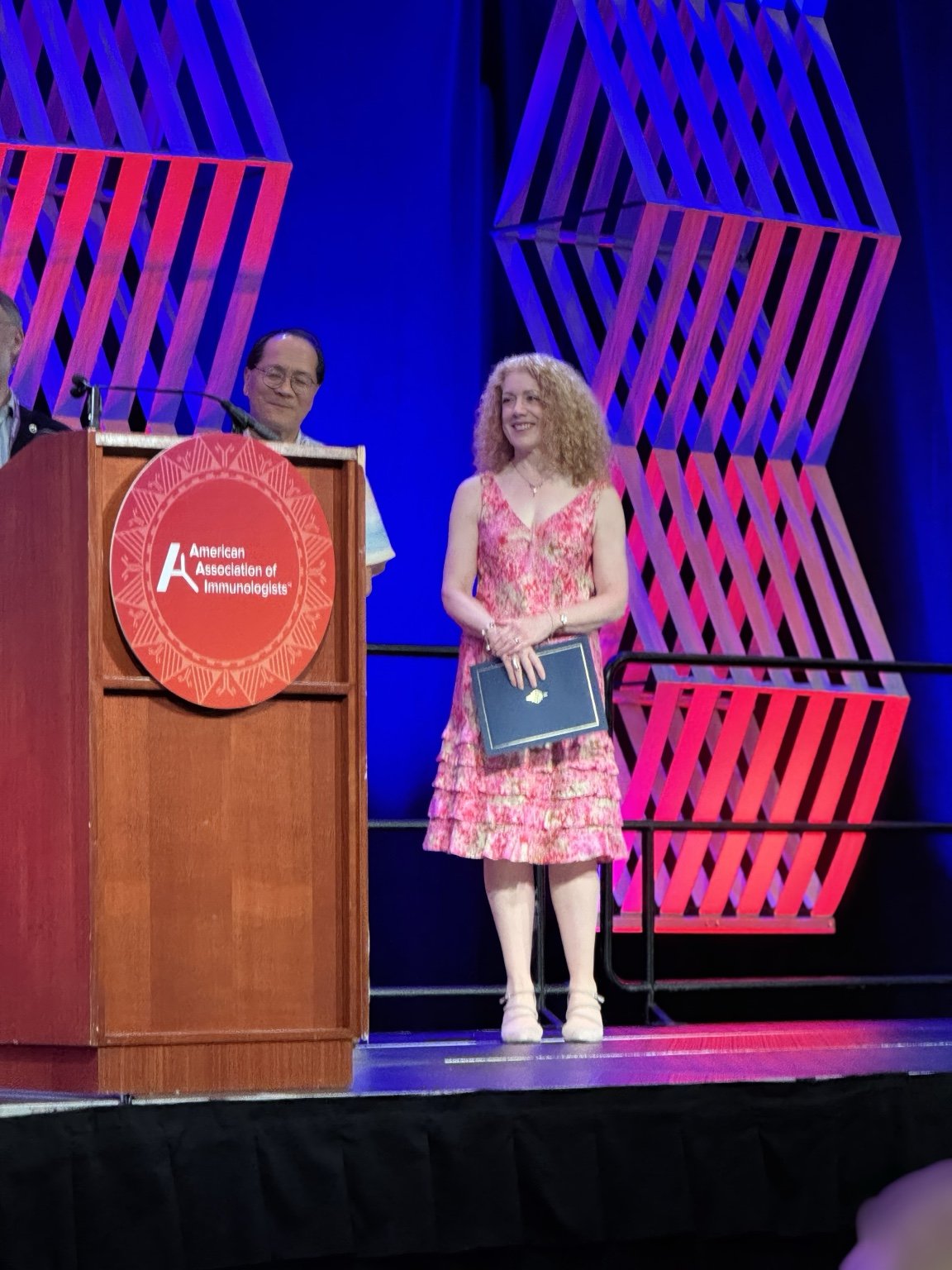
Dr. Lisa Butterfield receiving the American Association of Immunologists “Distinguished Fellow Award”.
Reaching the Top, then Using it
Dr. Butterfield’s election as the first female president of the Society for Immunotherapy of Cancer (SITC), after more than 30 years of the society’s existence, was a historic achievement. But the deeper significance lies in what she chose to do with that position. She did not treat it as ceremonial culmination. She treated it as leverage.
The priority she chose was the advancement of women in science, shaped directly by her own experience of delayed and inadequate mentorship. She is candid about what that absence cost her early in her career: time, momentum, and a smoother trajectory. “The lack of mentoring impacts your career stage, your career progress,” she says. Given the opportunity to act, she helped create the Women in Immunotherapy Network and related leadership efforts within SITC, structures designed not merely to inspire, but to alter conditions for others coming up through the field.
That choice is highly revealing in the context of her career. Many people reach influential positions. Fewer use them to correct what they themselves experienced as structural harm. Dr. Butterfield’s reflections suggest that part of staying at the top, for her, has meant refusing to interpret personal success as proof that the system is fair. She remains clear that it is not. Her account of ongoing barriers facing women across academia, biotech, and pharma is not nostalgic, it is contemporary. Leadership, in that context, means more than visibility. It means building mechanisms strong enough to outlast one’s own term in office.
Creating an Environment of Professional Seriousness
Dr. Butterfield’s approach to mentoring and leadership is unusually clear-eyed. She is not interested in sentimental language about leadership, nor in performing intimacy as a substitute for standards. What she values in younger scientists is not charm, but seriousness: enthusiasm, drive, resilience, and the capacity to recover from failure without becoming paralyzed by it. She wants people to be truly excited by science, because without that energy the profession becomes unsustainable. She wants them to have some sense of where they hope to go, because mentorship is strongest when it can be directed. And she wants them to withstand bad news, because science produces plenty of it.
Her own model of leadership reflects the same logic. She sees her role as creating the conditions for others to do strong work, removing roadblocks, advising when needed, and then stepping back. She is explicit that she is not trying to create a family atmosphere in the lab. She is trying to create an environment of professional seriousness. That candor is refreshing. In many settings, leadership is described in inflated or vaguely therapeutic language. Dr. Butterfield’s description is more practical and, in its own way, more respectful. She does not pretend to offer what she does not believe in. What she offers is clarity, structure, and the expectation that capable people will use both well.
That matters because one of the most important aspects of staying at the top is not becoming indulgent with one’s own mythology. Dr. Butterfield does not seem interested in being admired for style. She is interested in whether the work holds.
The Future
After decades in tumor immunology, Dr. Butterfield remains convinced that cancer vaccines may still be approaching a genuine breakthrough, but only if the field becomes more precise about what success actually means. Her optimism is disciplined, not promotional. In her view, the current moment matters for two reasons: the rise of personalized neoantigen vaccines, and the increasing use of randomized two-arm trials that can finally isolate the contribution of the vaccine itself. Without that rigor, the field risks returning to a familiar problem, compelling biology without definitive clinical meaning.
She is equally clear that immune profiling must move beyond showing activation alone. The central question is whether vaccine-induced T cells truly recognize tumor. “I think one of the biggest questions we have to answer is did the vaccine activate T cells that can see the tumor?”. “Until we’re activating T cells that see the tumor in a well-controlled trial, we’re not going to know what we’re doing. And the field will get tired again of unclear levels of success.”
That is what gives Dr. Butterfield’s optimism its authority. She is not simply hopeful about where the field is going. She is exacting about what it still must prove before progress can become durable, and before promise can become real benefit for patients.
What it Took to Lead at the Top
What it took for Dr. Lisa Butterfield to reach the top was not only talent, nor only persistence. It was the ability to recognize a meaningful scientific possibility early, remain intellectually honest about its limitations, and continue refining it without surrendering either to hype or to fatigue. What it took for her to stay at the top was something additional: the capacity to adapt leadership to different environments, to make rigor a habit rather than a slogan, to turn visibility into responsibility, and to keep patient benefit as the final measure of scientific value.
Near the end of the interview, she offers perhaps the most revealing summary of all. For a PhD scientist, she says, “to play a part in therapies that have helped patients is an enormous honor. And this is something that gets you up in the morning, and gets you to go back and learn what you did right and what you did wrong, and help people do better.”
That is the deeper answer to the question posed by this series. What it took her to lead at the top was not simply excellence in science. It was the discipline to keep asking, over decades, what might genuinely help patients, and the steadiness to build a life around that question, even when the field itself was not yet ready to reward it.